History of the Band
The history of Lockerley Silver Band spans over 140 years of music-making and community life. Compiled from research by Richard Taylor, and personal accounts from those who lived it.
A Brief History of the Band
The band was founded in 1880 as a Temperance Band, with Mr. Isaac Pritchard serving as its first conductor. Leadership later passed to his son, Caleb Pritchard, who held the position until his death during the Great War (1914–1918). Edwin Moody then took over the baton and played a pivotal role in affiliating the band with the Wessex Association, opening the doors to competitive participation.
The band's first significant achievement came in 1926 at a contest in Romsey, organised by Rev. E.F.M. Vokes as part of the Romsey Carnival. The band won first prize, along with individual accolades for D. Moody (solo cornet) and L. Pritchard (euphonium). This success spurred the band to further victories, earning numerous trophies throughout the late 1920s and 1930s, including two consecutive wins at the Amesbury Carnival Contest.
Edwin Moody led the band until the mid-1930s, when health issues forced his retirement. His son, Dave Moody, stepped into the role of conductor and remained in this position until 1949.
In 1949, the band secured the services of Mr. H.J. Stockwell from Swathling as its new musical director. Under Stockwell's leadership, the band achieved remarkable success. In 1950, they won the Wessex Brass Bands Open Championship. Within a single year, Stockwell also guided the band from Section 'C' to Section 'A' of the Wessex Brass Band Association.
Stockwell served as musical director for nearly 30 years, leading the band to numerous contest victories. He also played an influential role in the broader brass band community, serving as a member of the Executive Committee of the National Brass Band Contesting Council of Great Britain and as Honorary Secretary of the Wessex Brass Band Association.
Mr. Stockwell was honoured for 25 years of dedicated service to the band during a special presentation held at Dave Moody's Golden Wedding celebration.
After more than a century in the Parish Room, Lockerley Parish Council voted to evict the band — bringing to an end the band's long-standing home. Read the full story.
Chronology of Conductors
A Life in Music: The Story of Charlie Sillence
Born in 1915 at Carters Clay, Mr. Charlie Sillence's lifelong journey with music began at the age of nine when his father, Mr. Walter Sillence, taught him to play the cornet. In 1925, at just ten years old, Charlie joined the Lockerley Band and received further musical instruction from Mr. David Moody.
Charlie's enthusiasm for music was evident early on. Before his parents could afford a bicycle, he walked from Newtown to Lockerley for band practices, a clear testament to his dedication. His progress as a young musician was swift. That same year, he participated in the inaugural Wessex Summer Contest at Downton and continued to compete in contests, including one in Romsey the following year. From that point onward, Charlie played in every contest, establishing himself as a fixture in the local music scene.
Like many of his generation, Charlie's musical career was interrupted by war. In January 1942, he joined the Army, serving as a Physical Training and Aircraft Recognition instructor with an Anti-Aircraft Battery in Malta. He returned to England in November 1945 and promptly resumed his role in the Lockerley Band, performing as a solo cornet under the guidance of Mr. Moody.
By 1948, Charlie had assumed the position of lead solo cornet, succeeding his mentor. Over his career, he earned an impressive eleven medals for solo cornet performances, including an extraordinary feat of winning four consecutive contests in a single year.
Beyond his talent as a musician, Charlie played an instrumental role in sustaining the Lockerley Band. He became Honorary Secretary in 1950 and Treasurer in 1956, ensuring the band's operations continued smoothly. His contributions extended beyond Lockerley; he served as a solo cornet for the Romsey Methodist Circuit Band and as a trumpeter for the Wellow and Nomansland British Legion.
As if his musical achievements weren't enough, Charlie also dedicated 42 years as a bell ringer at St. Leonard's Church in Sherfield English. His life stands as a shining example of passion, service, and community involvement.
John Wilkins — A Musical Journey
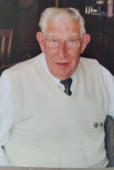
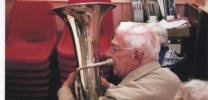
John Wilkins was born in 1928 in Newbridge, near Copythorne. Although his parents weren't musical, his own journey into music began at the age of 10 when a friend at Copythorne School — who lived at Pollards Moor — told him about the Cadnam Band. Intrigued, John decided to go along, and was given a cornet to play.
He received his first lessons from the bandmaster, Frank Lovell, who taught him in his own kitchen. Frank was also the father of Marion Bungay. At that time, the Cadnam Band practised in a hut next to the White Hart pub in Cadnam.
However, John didn't feel entirely comfortable with the cornet, and soon switched to the E flat bass — a position he would stick with throughout his musical career, occasionally switching to B flat bass for contests.
During the Second World War, the Cadnam Band managed to keep going thanks to its older members. They took part in wartime fundraising events such as Wings for Victory Week, Buy a Tank, and Buy a Spitfire. John recalls one memorable occasion when the band marched for five miles through the Cadnam area, raising money for the war effort.
Eventually, the Cadnam Band folded as many of its ageing members could no longer continue. The band's instruments were shared out: Marion received one, her brother got several, and John was given an old E flat bass. The band had very little sheet music, but John was handed a set of Wright and Round books — ideal for small groups of 10–12 players. He recalls playing marches like Staunch and True and waltzes such as Humpty Dumpty and Heartsease from these collections.
After Cadnam disbanded, John stopped playing for a time. It wasn't until 1955 that he returned to banding, when an old Cadnam bandmate who had joined Lockerley Band invited him along. Two years later, John officially joined Lockerley to fill an E flat bass vacancy. He played alongside Walter Sillence (Charlie's father), who also played E flat bass.
At that time, many members of the Lockerley Band were Baptists and Methodists. John also played alongside Michael Pritchard, the grandson of Isaac Pritchard. Over the years, John eventually became the bandmaster at Lockerley, before later returning to his original role on the E flat bass.
Music became a family affair — his daughter Joan played tenor horn, as did his wife, Joyce. When John first joined in 1955, there were no women in the band. However, when the group needed a tenor horn player for a particular event, they made the decision — after some serious discussion — to allow Joyce to join. She remained part of the band until her death in 1985.
Other Recollections of Lockerley Band
Lockerley Band's Beginnings
An old drum from the bandroom bore the words "Lockerley Band Established 1880," serving as a nostalgic reminder of its long-standing history.
David Moody (the Elder)
David Moody, affectionately known as "the elder," was a cornerstone of Lockerley Band. He lived across from the King's Arms in Lockerley and visited the bandroom daily to examine the music. A true multi-instrumentalist, he played all the instruments in the band, favouring the cornet and the E flat bass.
During World War I, David served in an army band stationed in the UK, playing music during long marches of eight miles in the morning and another eight miles in the afternoon — a task he much preferred to cooking duties. Later, he became a market gardener near Carter's Clay and worked at the Dean ammunition dump during World War II. David's legacy in the band continued through his son, also named David, who became a member as well.
Conductors and Contest Memories
A. Halestrap served as guest conductor for the contest on 13th July 1946.
D. Judd served as guest conductor for the contest on 16th June 1962, hailing from Shaftesbury Town Band. Judd, a farmer from Sixpenny Handley, brought a rustic charm to the occasion.
The Bandroom and Squatters' Rights
At one point, before John Wilkins became bandmaster, the vicarage — where the bandroom was located — was set to be sold, and the band was given just one month's notice to vacate. David Moody (the elder) was the bandmaster at the time. Although the band had always performed for the village fete free of charge and paid no rent, Joyce (likely a band member or supporter) argued they had squatters' rights after occupying the space for over 25 years. Ultimately, the church transferred the room to the Parish Council with the agreement that the band could continue using it rent-free.
A Costume Mishap
At a concert held at Lockerley Memorial Hall in the late 1970s, the band decided to incorporate costumes. John Wilkins, determined to add flair, chose a Turkish outfit. Ignoring his wife Mary's advice on the impracticality of his choice, John crafted the outfit himself using sheer red material and a homemade fez. When the stage lights illuminated the flimsy costume during his entrance, the audience erupted in laughter — it revealed far more than intended!
A Tragic Passing and Memorable Moments
Ernie Sillence, a relative of Charlie Sillence, passed away in the bandroom while playing The Acrobat by Greenwood on the trombone, under John Wilkins' direction. Later, Charlie Sillence, a solo cornet player, suffered a stroke in the 1980s.